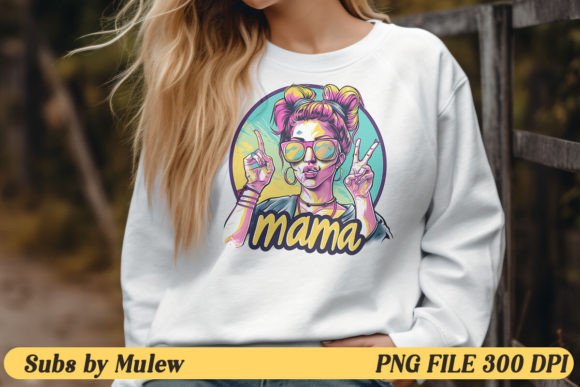
Review: Pop Art Mama Mother's Day Sublimation for Embroidery
As a designer who spends more time staring at stitch maps than actual fabric, I am always skeptical when I see a sublimation graphic pitched for embroidery projects. The Pop Art Mama Mother s Day Sublimation design immediately caught my eye with its bold, retro comic-book aesthetic. However, translating a vibrant digital graphic into a tactile machine embroidery design requires a critical eye. This isn't just about slapping a image onto a shirt; it is about understanding how those thick black outlines and halftone dots translate into thread, stabilizer, and fabric texture.
My first impression of this Graphics asset is that it screams personality. The mood is celebratory, loud, and unapologetically fun, perfectly capturing the "supermom" vibe without being cheesy. For an Etsy seller or craft business owner, this visual personality is gold. It stands out in a sea of delicate floral scripts and generic hearts. However, from a technical standpoint, the high-contrast nature of pop art presents specific challenges. The heavy black outlines suggest a need for precise satin stitching, while the colorful fills will require careful management of stitch density to avoid turning a soft sweatshirt into a cardboard-like patch.
Real-World Application: The Boutique Tote Bag Scenario
To truly evaluate this design, I imagined a specific real-life scenario: creating a limited run of custom tote bags for a local boutique's Mother's Day promotion. The goal was a handmade product that felt premium yet playful. Using the Pop Art Mama Mother s Day Sublimation concept as a base for digitizing (or adapting an existing embroidery file), the project came to life on a heavy canvas tote.
The result was striking. The thick contours of the comic illustration held up beautifully against the textured weave of the canvas. Unlike fine-line designs that get lost in rough fabrics, the bold shapes of this Retro Mama Portrait style commanded attention. Customers reacting to the finished bag didn't just see a gift; they saw a statement piece. The vibrancy of the colors, when matched with high-sheen rayon threads, mimicked the pop art feel effectively. This confirms that the design is ideally suited for custom apparel and accessories where the fabric has enough weight to support the stitches without puckering.
Performance Across Different Products
While the tote bag was a success, moving this design to other substrates requires different strategies. Here is how I see this embroidery project performing across various items:
- Sweatshirts and Hoodies: This is arguably the best home for this design. The fleece provides a plush background that makes the fill stitch areas pop. The retro vibe pairs naturally with collegiate-style garments.
- Embroidered Patches: Creating a merrow-edge patch using this artwork would be incredibly effective. The defined borders of the pop art style make it easy to cut and finish, creating a high-value small shop product.
- Baby Embroidery: Caution is needed here. While cute, the density required to replicate the solid color blocks of pop art might be too stiff for delicate baby skin. If used on a onesie, I would recommend reducing density significantly or using it as an appliqué base.
- Caps and Hats: The curved surface of a cap can distort wide designs. Since this graphic likely features a portrait orientation, it fits well on the front panel, but the detailed facial features must be large enough to stitch clearly on the structured fabric.
Technical Considerations and Fabric Constraints
Every designer knows that a great screen image does not guarantee a great finished product. There are specific areas where the Pop Art Mama Mother s Day Sublimation style demands careful handling. First, consider the hoop size. If the original graphic is intricate, you may need a larger hoop to maintain the integrity of the details without cramming stitches together. Cramped stitching leads to thread breaks and bird nests.
Textured fabrics like waffle knits or heavy linens can interfere with the clean lines essential to the comic book look. On these materials, a underlay stitch is non-negotiable to create a smooth foundation. Furthermore, if you are working with stretchy fabrics like jersey knits for t-shirts, the dense color fields typical of pop art can restrict stretch and cause the garment to warp. In these cases, treating the design more like an applique design—using the graphic as a cut-out shape rather than a fully filled area—might be the smarter commercial move.
Dark fabrics present another hurdle. The vibrant colors described in the Vibrant Mom Pop Art Graphics category rely on brightness. Stitching light colors over dark fabric requires a dense white underlay, which adds bulk. If the design includes tiny lettering or minute halftone dots, these details may vanish or blur on dark backgrounds. Always test a printable mockup or a physical sample on the intended fabric color before committing to a production run.
Enhancing Brand Value and Customer Trust
Ultimately, the choice of design affects your brand consistency. Using a high-quality, well-executed version of this Mother s Day Comic Illustration signals professionalism. It tells the customer that you care about trends and quality. A sloppy execution with visible gaps in the satin columns or uneven fill patterns will erode trust instantly. For commercial embroidery, consistency is key. If you sell this as a personalized gift, the recipient expects perfection.
The visual appeal of this design lies in its clarity. When stitched correctly, the separation between colors creates a crisp, modern look that elevates the perceived value of the item. Whether it is a kitchen towel, a pillow cover, or a holiday gift, the distinct style makes it instantly recognizable as a boutique item rather than a mass-produced good.
Practical Notes for the Working Designer
Before you load this into your machine, here are my top recommendations for ensuring success with this type of graphic:
- Test on Scrap First: Never skip this step. Run the design on the exact fabric and stabilizer combination you plan to use for the final product.
- Check Thread Contrast: Pop art relies on high contrast. Ensure your thread colors match the vibrancy of the original Graphics file. Dull threads will kill the retro vibe.
- Review Stitch Density: If the digitized file feels too heavy, manually reduce the density in your software to prevent fabric distortion.
- Inspect Small Details: Zoom in on the eyes and mouth of the portrait. Are the stitches too small to form properly? Simplify if necessary.
- Verify Licensing: Since this originates as a sublimation design, confirm if you have the rights to use it for digital embroidery file creation or if you are purchasing a pre-digitized version. Selling finished items versus selling the file itself often has different license terms.
- Stabilizer Selection: For heavy fill areas, a cut-away stabilizer is usually safer than tear-away to prevent long-term shifting and puckering.
In conclusion, the Pop Art Mama Mother s Day Sublimation concept offers a fantastic opportunity for creative entrepreneurs to break away from traditional floral motifs. With thoughtful adaptation to the constraints of thread and fabric, it can become a standout star in your Crafts inventory. Just remember: the magic isn't just in the image, but in how skillfully you translate that pixelated energy into stitched reality.